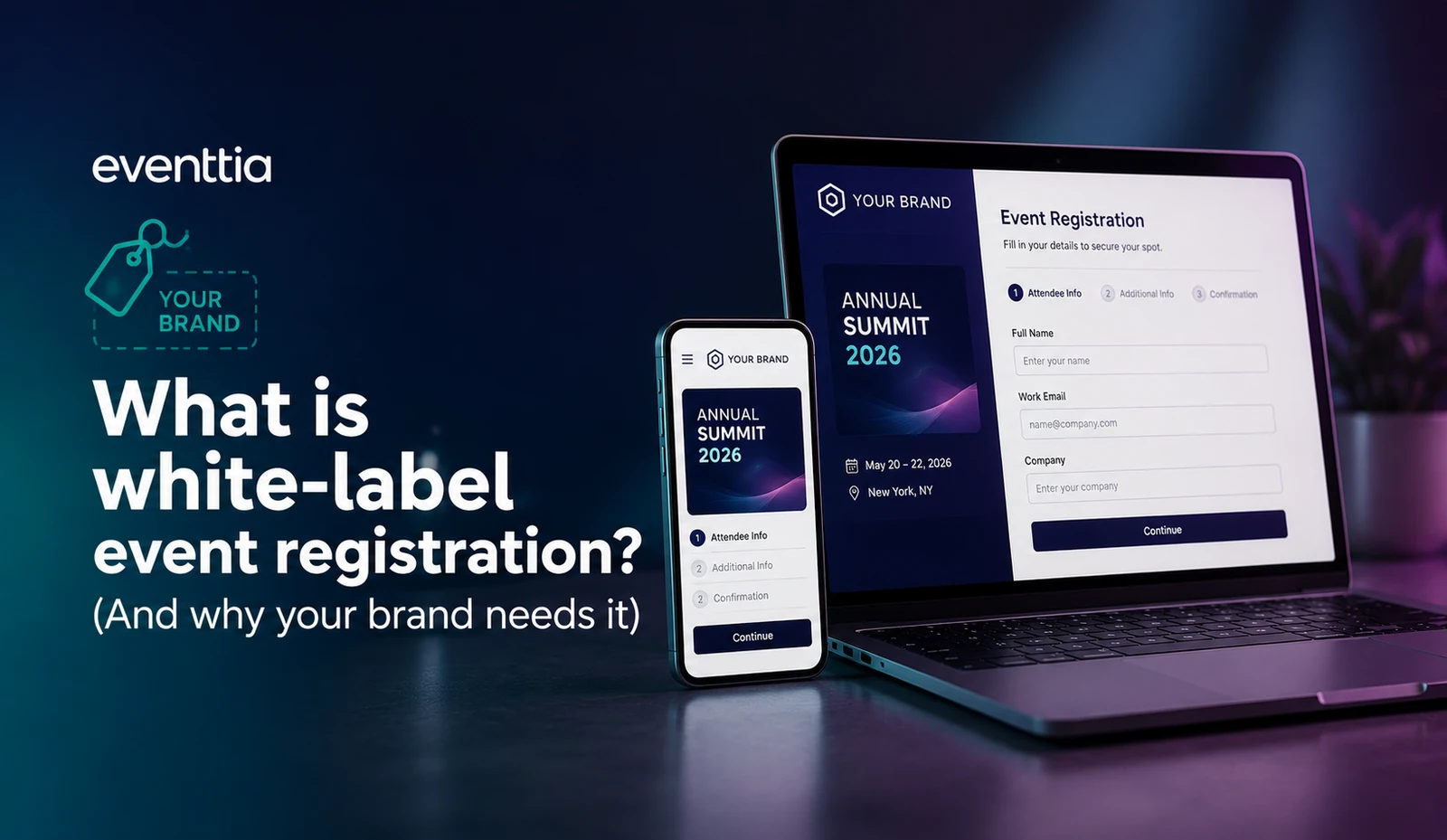
Every time an attendee registers for your event and sees another company’s logo on the form, you lose a little bit of brand equity. White-label event registration fixes that.
White-label event registration is a software capability that lets event organizers fully brand every registration touchpoint: custom domain, registration forms, confirmation emails, event pages and, with platforms like Eventtia, native API embedding into the organizer’s own website or mobile app, so attendees never see the software vendor behind the scenes. True white-label goes far beyond a logo swap or color change. The organizer’s brand is the only brand the attendee encounters, from first click to final confirmation.
Whether you run conferences, trade shows, corporate seminars, galas or product launches, white-label registration helps you own the attendee journey from the very first touchpoint.
In this guide, we’ll break down exactly what white-label event registration is, why it matters, what features to look for and which platforms do it best in 2026.
Quick summary: white-label event registration at a glance
| Question | Answer |
| What is it? | Event registration software that removes vendor branding so attendees only see your brand |
| Who needs it? | Event organizers, marketing teams, agencies and enterprises that value brand consistency |
| Key features | Custom domains, branded forms, branded emails, branded event pages, API integration |
| Top platform for full white-label | Eventtia, white-label across every registration touchpoint |
| Typical cost | $1,650 to $18,000+ per year depending on attendee volume and features |
| Build vs. buy? | Buying a white-label platform is 5-10x faster and cheaper than building custom registration |
What does white-label event registration actually mean?
White-label event registration is a feature offered by event management platforms that allows organizers to completely remove the software vendor’s branding from the registration process and replace it with their own, covering custom domains, registration forms, email communications, event pages and, at the deepest level, API-based embedding that lets brands like Nike run registration natively inside their own website or app without any redirect to a third-party platform. This includes registration forms, confirmation pages, email communications and event websites, all displaying only the organizer’s brand, logo, colors and domain.
Think of it this way: the software company builds the engine, but your brand is the only thing attendees see on the outside.
In practice, white-label event registration means your attendees will register through a form hosted on your domain (like events.yourcompany.com), receive confirmation emails from your email address (like events@yourcompany.com) and land on event pages that look and feel like they were built by your own team. There is no “powered by” footer. No third-party logo. Just your brand.
This is different from basic branding options like uploading a logo or changing a color scheme. True white-label registration goes deeper: custom domains, branded sender addresses, fully customizable form layouts and API access so the registration flow integrates seamlessly with your existing tech stack.
According to a 2025 Freeman survey, 78% of event attendees say brand consistency across event touchpoints directly influences their perception of the hosting organization. That is why white-label registration has moved from a “nice-to-have” to a requirement for enterprise events.
What is the difference between white-label and standard event registration?
The main difference between white-label and standard event registration is brand ownership. Standard registration displays the software vendor’s branding alongside yours, while white-label registration removes all vendor branding so attendees only interact with your brand throughout the entire registration process.
Here is a side-by-side comparison:
| Feature | Standard registration | White-label registration |
| Registration form URL | vendor-domain.com/your-event | events.yourcompany.com |
| Sender email address | noreply@vendor.com | events@yourcompany.com |
| Vendor logo on forms | Yes, usually in footer | No, fully removed |
| “Powered by” badge | Visible to attendees | Removed entirely |
| Form design flexibility | Limited to templates | Full control over colors, fonts, layouts |
| Event page branding | Vendor template with your logo | Fully custom design matching your brand |
| Attendee perception | “They use [Vendor] for events” | “They have their own event platform” |
| Data ownership | Shared or vendor-controlled domain | Your domain, your data environment |
For small community meetups or free workshops, standard registration is usually fine. But for corporate conferences, luxury brand activations, trade shows and any event where brand perception matters, white-label registration is the way to go.
The difference is especially important for organizations in regulated industries (finance, healthcare, government) or luxury sectors where every touchpoint needs to reinforce trust and brand authority.
Why do event organizers need white-label event registration?
Event organizers need white-label event registration because it gives them full control over the attendee experience from the first interaction, builds trust through brand consistency and keeps attendee data within their own branded ecosystem. For organizations that run multiple events per year, it also creates a unified, professional experience that scales.
Brand consistency across the entire attendee journey
Your event brand starts long before the keynote speech. It starts at registration. When an attendee clicks a registration link and lands on a page that matches your website, receives a confirmation email from your domain and checks in using an app with your logo, the entire experience feels cohesive and intentional.
According to Marq’s 2024 Brand Consistency Report, companies that maintain consistent branding across all channels see an average revenue increase of 10-20%. Events are no exception. If your registration page looks like it belongs to a different company than your website, you are breaking the brand chain at the most critical conversion point.
This is why global brands like Ralph Lauren, Patek Philippe and Cartier invest in white-label event registration. Their events must feel like a seamless extension of the brand experience, not a redirect to an unfamiliar third-party page.
Higher trust and conversion rates
Registration is where you ask attendees to share personal information: name, email, phone number, company, job title and sometimes payment details. When the registration form sits on an unfamiliar domain with another company’s logo in the footer, some attendees hesitate.
White-label registration removes that friction. Attendees stay on your domain, interact with your brand and feel confident they are sharing information with you, not a third party they have never heard of. Event organizers who switch to white-label registration commonly report higher form completion rates because attendees trust the branded experience more.
For luxury and premium brands, think Cartier, Pernod Ricard or Patek Philippe, this is non-negotiable. Their customers expect every digital touchpoint to reflect the brand’s standards, and a registration page hosted on a generic vendor domain breaks that expectation immediately.
Enterprise-grade customization without building from scratch
Building a custom event registration system from scratch requires months of development time, ongoing maintenance and a dedicated engineering team. White-label event registration platforms give you the same result, a fully branded, custom-looking registration experience, without the development overhead.
You get the flexibility of a custom build with the reliability, support and speed of a SaaS platform. That is why enterprise teams at companies like Nike, Sony, Ralph Lauren, Pernod Ricard and Patek Philippe use white-label platforms like Eventtia instead of building in-house.
What features should a white-label event registration platform include?
A white-label event registration platform should include custom domain hosting, branded registration forms, branded email delivery, customizable event pages and API access for integrations. These are the essential features that ensure every attendee touchpoint carries your brand.
Here is the full checklist:
- Custom domain hosting for registration pages (e.g., events.yourcompany.com)
- Branded registration forms with full control over colors, logos, fonts and layouts
- Branded email delivery from your own domain (e.g., events@yourcompany.com)
- Customizable event pages and websites matching your visual identity
- White-labeled email templates for confirmations, reminders and follow-ups
- API access for connecting with your CRM, marketing automation and data tools
- SSO (Single Sign-On) and role-based access for enterprise security
- Multi-language support for international events
- Custom analytics dashboards under your brand
Let’s look at each core feature in detail.
Custom domain hosting
Custom domain hosting is the foundation of white-label event registration. Instead of attendees registering at vendor-platform.com/your-event, they register at events.yourcompany.com. This keeps the entire experience within your brand ecosystem and prevents attendees from feeling like they have been redirected to a third-party site.
Branded registration forms
Branded registration forms go beyond uploading a logo. True white-label forms let you customize every visual element: colors, fonts, field layouts, button styles, background images and form logic. Some platforms also support conditional fields (showing different questions based on attendee type), multi-step forms and payment integration, all within your branded design.
Branded email communications
Every email your attendees receive, registration confirmations, event reminders, schedule updates, post-event follow-ups, should come from your domain and carry your brand design. White-label email delivery means the sender address, email template and reply-to address all belong to you.
This is especially important for deliverability. Emails sent from your own authenticated domain (with proper SPF, DKIM and DMARC records) are far less likely to land in spam than emails sent from a generic vendor address.
Branded event pages and websites
Your event page is often the first thing a potential attendee sees. White-label platforms let you design event pages that match your website’s look and feel. This includes custom headers, footers, navigation, imagery and content, all hosted on your domain.
Some platforms offer drag-and-drop page builders, while others provide full HTML/CSS access for teams that want pixel-perfect control.
API access for custom integrations
API access lets you connect your white-label registration platform with your existing tools: CRM systems (Salesforce, HubSpot), marketing automation (Marketo, Mailchimp), data warehouses and internal databases. This ensures attendee data flows seamlessly into your broader tech stack without breaking the branded experience.
The best platforms offer unlimited API calls so you are never throttled during high-traffic registration periods.
Who uses white-label event registration? (Use cases by industry)
White-label event registration is used by any organization that needs to maintain brand control over the event experience. This includes luxury brands, corporate enterprises, government agencies, sports organizations and event agencies managing events on behalf of clients.
Global sports brands
Global sports brands use white-label event registration to scale community events across markets while maintaining a seamless brand experience. Nike, for example, selected Eventtia as its global event technology partner in 2022 to power the Nike Experiences program. Rather than using Eventtia’s standard interfaces, Nike integrated Eventtia’s back-end services directly into Nike.com and its mobile applications through Eventtia’s enterprise API, delivering a fully native registration experience for attendees across 5,000+ sporting events worldwide.
This deep API integration allowed Nike’s marketing teams, store managers and sports partners to plan, promote and manage community events from a single platform, while attendees experienced registration, event discovery and communications entirely within the Nike ecosystem. No third-party branding. No redirects. Just Nike. This is one example of white-label events for retail and consumer brands, where the guest experience stays with the brand.
“Love the partnership and will look forward to continued engagement.”
Joe Carfelli, Marketing Director at Nike
Corporate events and conferences
Large corporations running internal town halls, leadership summits, product launches or annual conferences need registration to feel like an extension of their internal communications. White-label registration ensures employees and external guests interact with a cohesive, professional experience that reinforces the company’s brand and culture.
Companies like Sony, Skyguide and Pernod Ricard use white-label registration to manage corporate events at scale across multiple countries and business units, ensuring that whether an attendee registers in Paris, Tokyo or New York, the brand experience is consistent.
Government and public-sector events
Government agencies and public-sector organizations often have strict branding guidelines and data sovereignty requirements. White-label registration ensures that citizen-facing event pages and forms carry the official government brand, and that attendee data stays within approved domains and infrastructure. Organizations like Comfama use Eventtia to run public-facing events with fully customized registration pages and communications that meet institutional branding and compliance standards.
Sports, galas and large-scale events
Sports organizations, gala dinner committees and festival organizers use white-label registration to create a premium attendee experience from the moment of sign-up. For ticketed galas and VIP sports events, a branded registration flow with integrated payments builds confidence and sets the tone for the event itself.
Event agencies and brand marketing teams
Event agencies and field marketing teams that manage events on behalf of multiple clients need white-label registration more than almost anyone. Without it, every client event displays the same vendor branding, which undermines the agency’s ability to deliver a custom, branded experience for each client.
With a true white-label platform, an agency can configure separate branded registration environments for each client, different domains, different logos, different email senders, all managed from a single back-end dashboard. This means the agency running 50 events across 10 different brands does not need 10 separate software accounts. They need one white-label platform with per-client branding capabilities.
This use case is especially important for agencies serving luxury brands (Cartier, Ralph Lauren, Patek Philippe) or global enterprises (Nike, Sony, Pernod Ricard), where brand guidelines are strict and any deviation is unacceptable. Eventtia’s enterprise API and multi-event management capabilities make it a strong fit for this use case, since agencies can manage all client events from one account while delivering fully branded experiences to each client’s attendees.
5 best white-label event registration platforms in 2026
Here is a comparison of the five best platforms for white-label event registration, focused specifically on registration capabilities. For a broader comparison of white-label event management platforms (including mobile apps, virtual events and attendee engagement), see our full guide: 10 best white-label event management platforms in 2026.
| Platform | Best for | White-label registration features | Pricing |
| Eventtia | Advanced and comprehensive registration management | Custom domain, branded forms, branded emails, branded event pages, enterprise API with unlimited calls | From $1,650/year |
| Eventify | Branded event apps with registration | Branded mobile event app, customizable event website, in-app registration, branded push notifications | Contact for pricing |
| RSVPify | Premium invitations and RSVP management | Custom-branded RSVP pages, branded email invitations, customizable form design, custom URL options | Free tier available; paid plans from ~$19/month |
| EventBookings | Event registration and ticketing | Branded event pages, customizable registration forms, branded ticketing and confirmations | Contact for pricing |
| CrowdComms | Event apps and audience engagement | Branded event app, customizable event platform, branded registration within app, custom branding options | Contact for pricing |
Eventtia: best for white-label registration with advanced and comprehensive registration management
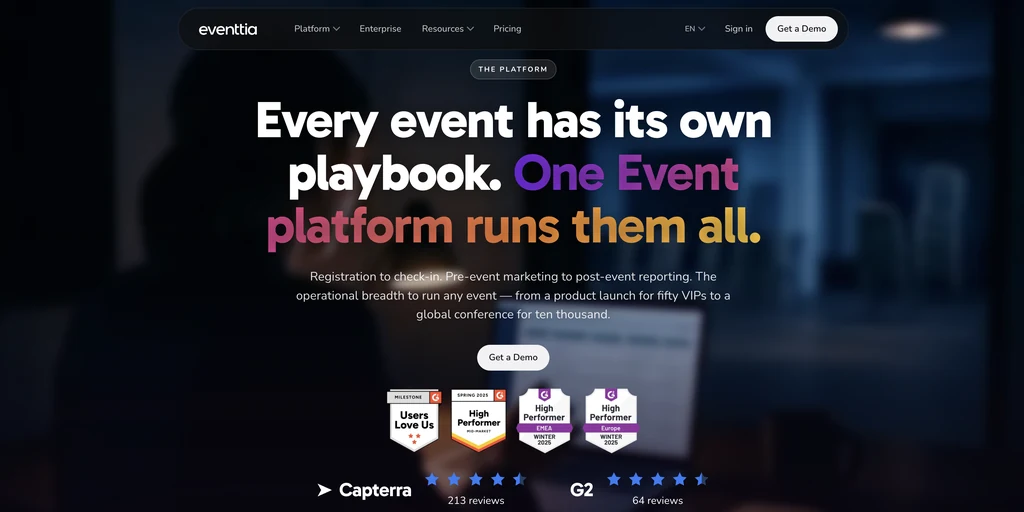
Rating: 4.5/5 (300+ reviews on G2, Capterra and TrustRadius)
Eventtia is a top choice for organizations that need full white-label control over every registration touchpoint. Unlike platforms that only offer partial branding (a logo swap here, a color change there), Eventtia lets you white-label the entire registration journey: custom domain hosting, branded registration forms, branded email delivery from your own domain, branded event pages and enterprise-grade API services for deep integrations.
What makes Eventtia’s registration white-label stand out:
- Custom domain hosting: Host registration on your own domain (events.yourcompany.com) with a simple DNS setup.
- Branded registration forms: Full control over colors, logos, fonts, field layouts and form logic, including conditional fields, multi-step forms and integrated payments.
- Branded email delivery: All registration emails (confirmations, reminders, follow-ups) are sent from your domain with your templates.
- Branded event pages: Build event pages that match your website design. No Eventtia branding anywhere.
- Enterprise API with unlimited calls: Integrate Eventtia’s back-end services directly into your website and mobile apps for a fully native registration experience, like Nike did with Nike.com.
- Enterprise security: SSO, audit logs, role-based access and GDPR-compliant data handling.
Who uses it: Nike (5,000+ events globally since 2022), Sony, Ralph Lauren, Patek Philippe, Skyguide and Comfama. Eventtia powers over 35,000 events for more than 12 million registered attendees worldwide.
Pricing: Eventtia’s pricing plans start at $1,650/year for 250 attendee credits. All plans include unlimited events and white-label features.
Eventify: best for branded event apps with built-in registration
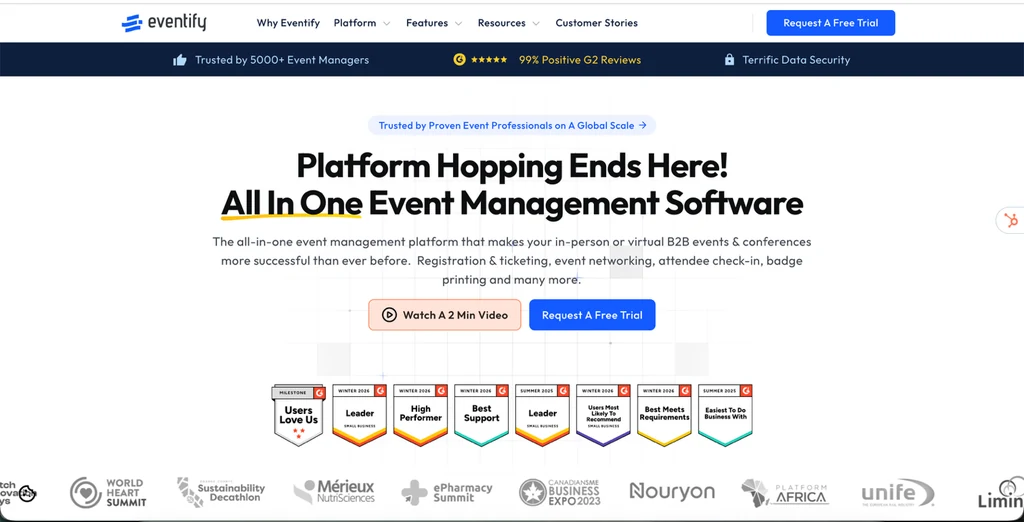
Rating: 4.8/5 (68 reviews)
Eventify is an event app and engagement platform that helps organizers create branded mobile experiences for conferences, trade shows and corporate events. Its core strength is the customizable event app, which includes built-in registration, attendee networking and engagement features, all under the organizer’s brand.
Key white-label registration features:
- Branded mobile event app: Fully customizable event app with your logo, colors and splash screen.
- In-app registration: Attendees can register directly within the branded app experience.
- Customizable event website: Build event landing pages with your branding to drive registrations.
- Branded push notifications: Send event updates and reminders through the branded app.
Best for: Organizers of conferences and trade shows who want a branded mobile-first registration and engagement experience.
Pricing: Contact Eventify for pricing details.
RSVPify: best for premium invitations and RSVP management
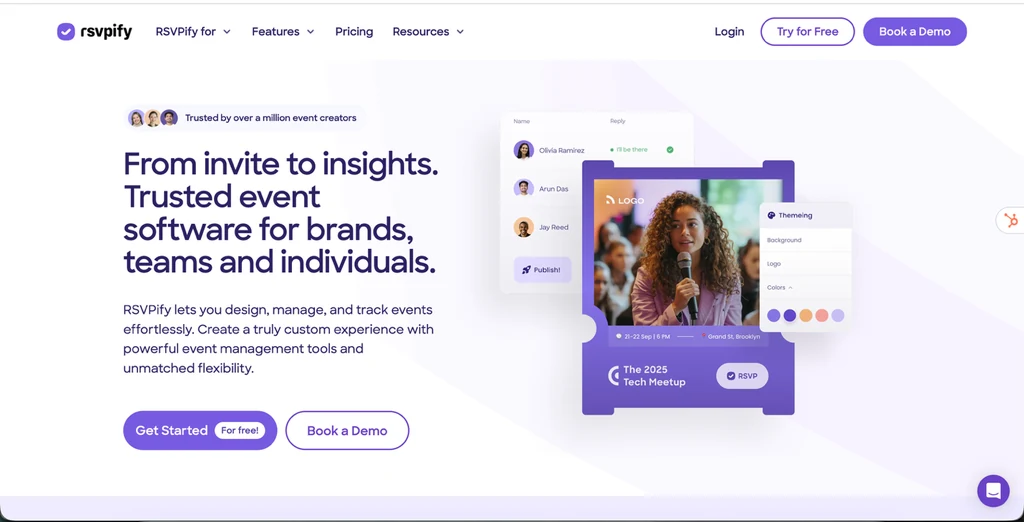
Rating: 4.8/5 (425 reviews)
RSVPify is a registration and RSVP platform built for organizers who need polished, branded invitation and registration experiences. The platform is popular for corporate galas, formal events, fundraisers and any event where the registration touchpoint needs to feel premium.
Key white-label registration features:
- Custom-branded RSVP pages: Design registration and RSVP pages with your colors, logo, fonts and imagery.
- Branded email invitations: Send designed invitations and confirmation emails with your branding.
- Customizable form design: Full control over form fields, layout and styling to match your brand.
- Custom URL options: Use branded URLs for your event registration pages.
Best for: Organizations hosting formal or high-end events (galas, fundraisers, corporate dinners) that need elegant, branded RSVP and registration flows.
Pricing: Free tier available for basic events. Paid plans start from approximately $19/month. Contact RSVPify for enterprise pricing.
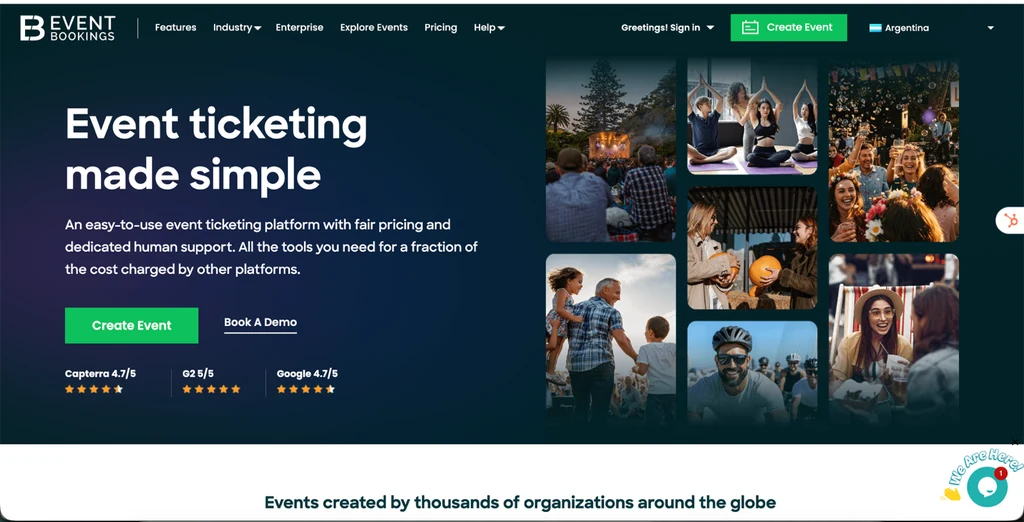
EventBookings: best for event registration and ticketing
Rating: 4.7/5 (21 reviews)
EventBookings is an event registration and ticketing platform that provides organizers with tools to create branded event pages, manage registrations and sell tickets. The platform serves a range of event types from workshops and seminars to large conferences.
Key white-label registration features:
- Branded event pages: Create event listing pages customized with your logo, colors and imagery.
- Customizable registration forms: Tailor registration form fields and design to match your brand.
- Branded ticketing: Issue tickets with your branding for paid events.
- Branded confirmation emails: Customize confirmation and reminder emails with your brand elements.
Best for: Event organizers who need a straightforward platform for branded registration and ticketing, particularly for paid events and workshops.
Pricing: Contact EventBookings for pricing details.
CrowdComms: best for event apps and audience engagement
Rating: 4.7/5 (30 reviews)
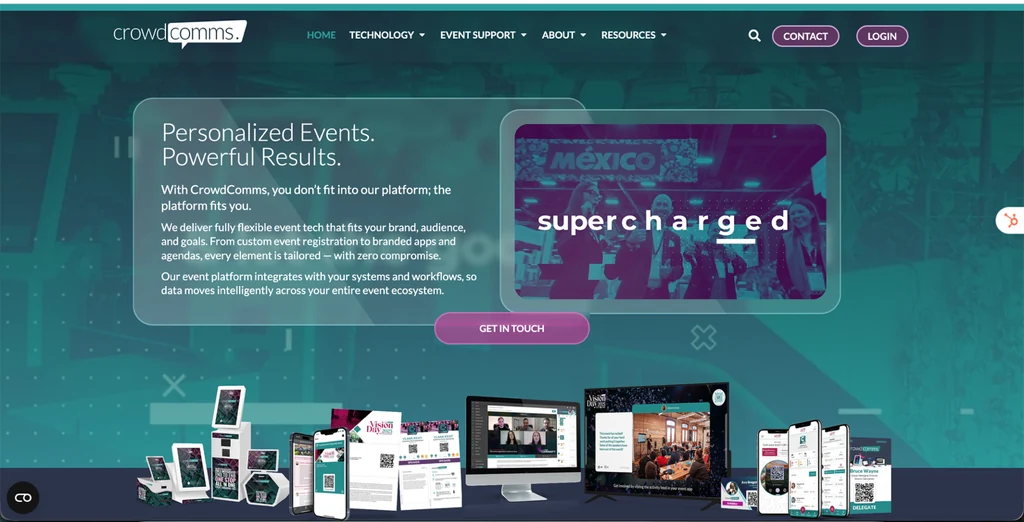
CrowdComms is a UK-based event technology company specializing in branded event apps, audience engagement tools and virtual/hybrid event solutions. The platform serves conferences, corporate events and trade shows with a focus on attendee engagement and networking.
Key white-label registration features:
- Branded event app: Fully customizable mobile app with your branding, including custom icons and design.
- Customizable event platform: Build branded event websites and virtual event spaces.
- Branded registration within app: Registration flows embedded within the branded app experience.
- Custom branding options: Apply your visual identity across the event platform, including colors, logos and layouts.
Best for: Conference and corporate event organizers who want a branded event app with integrated registration and strong audience engagement features.
Pricing: Contact CrowdComms for pricing details.
How to set up white-label event registration (step by step)
Setting up white-label event registration typically takes between one day and two weeks, depending on the platform and the level of customization you need. Here is the general process:
Step 1: Choose a white-label event registration platform. Evaluate platforms based on the checklist above. Prioritize those that offer white-label on all plans (like Eventtia) rather than reserving it for enterprise tiers.
Step 2: Configure your custom domain. Set up a subdomain (like events.yourcompany.com) and configure the DNS records to point to your registration platform. Most platforms provide step-by-step instructions for this.
Step 3: Set up branded email delivery. Authenticate your email domain (SPF, DKIM, DMARC records) so all registration emails are sent from your domain. This improves deliverability and reinforces brand trust.
Step 4: Design your branded registration forms. Customize your registration forms with your brand colors, logo, fonts and field layouts. Set up conditional logic if you need different forms for different attendee types (VIPs, speakers, general attendees, media).
Step 5: Build your branded event pages. Create event pages that match your website’s design. Add event details, schedules, speaker information and FAQs, all under your brand.
Step 6: Connect your integrations. Use the platform’s API to connect with your CRM, marketing automation, analytics tools and any other systems in your tech stack.
Step 7: Test the full attendee journey. Register as a test attendee and go through every step: form submission, confirmation email and event page. Make sure every touchpoint shows your brand and nothing else.
White-label event registration vs. building your own: which is better?
For most organizations, buying a white-label event registration platform is better than building custom registration software. A white-label platform delivers the same branded experience at a fraction of the cost and time, with ongoing updates, support and security handled by the vendor.
Here is how the two options compare:
| Factor | White-label platform | Custom-built registration |
| Time to launch | Days to weeks | 3-12 months |
| Cost | $1,650 to $18,000+/year | $50,000 to $200,000+ upfront |
| Ongoing maintenance | Handled by vendor | Your engineering team |
| Feature updates | Automatic, included | You build every update |
| Scalability | Built for thousands of events | Depends on your architecture |
| Support | Vendor support team | Your internal team |
| Customization depth | High (with API access) | Unlimited (but expensive) |
The only scenario where building makes sense is when your registration requirements are so unique that no platform on the market can accommodate them, and you have the engineering team and budget to support a custom build long-term. For 95% of organizations, a white-label platform is the smarter choice.
Frequently asked questions about white-label event registration
Can I use my own domain for event registration?
Yes. White-label event registration platforms let you host registration pages on your own subdomain (like events.yourcompany.com). This is done through a DNS configuration that points your subdomain to the platform’s servers. Platforms like Eventtia make this setup straightforward and include custom domain hosting on all plans.
Is white-label event registration worth the cost?
For any organization that values brand consistency, the answer is yes. White-label registration builds attendee trust, improves form completion rates and ensures your brand is the only one attendees see. The cost is also significantly lower than building a custom registration system in-house. Plans start at $1,650/year with Eventtia.
What is the difference between white-label and custom-built registration?
White-label registration uses an existing platform that removes the vendor’s branding and replaces it with yours. Custom-built registration is software developed from scratch by your own team. White-label is faster, cheaper and easier to maintain. Custom-built offers unlimited flexibility but requires significant development resources and ongoing investment.
Which platforms offer white-label event registration?
The leading platforms for white-label event registration in 2026 include Eventtia (full white-label across all touchpoints), Eventify (branded event apps with built-in registration), RSVPify (premium invitations and RSVP management), EventBookings (registration and ticketing) and CrowdComms (event apps and audience engagement). For a detailed comparison of the broader white-label event management market, see our 10 best white-label event management platforms in 2026 guide.
Do I need technical skills to set up white-label registration?
Most modern platforms are designed for event professionals, not developers. Setting up white-label registration typically involves configuring a subdomain (which your IT team can do in minutes) and customizing forms through a visual builder. API integrations may require developer support, but the core setup is no-code.
Next steps
White-label event registration is no longer a luxury feature reserved for the biggest enterprise budgets. It is a practical, affordable capability that any organization can use to deliver professional, on-brand event experiences.
If brand consistency matters to your events, and it should, start by evaluating how your current registration flow looks to attendees. If they see another company’s name anywhere in the process, you have room to improve.
The most comprehensive option for white-label event registration is Eventtia, which lets you brand every registration touchpoint: custom domain, forms, emails and event pages. Plans start at $1,650/year.
Eventtia is the platform behind the brands setting the standard.
Talk to us about how the platform fits into your stack: registration, communications, on-site and analytics, exposed deeply enough to compose.